

How to Compare Two Residential Properties Before Buying
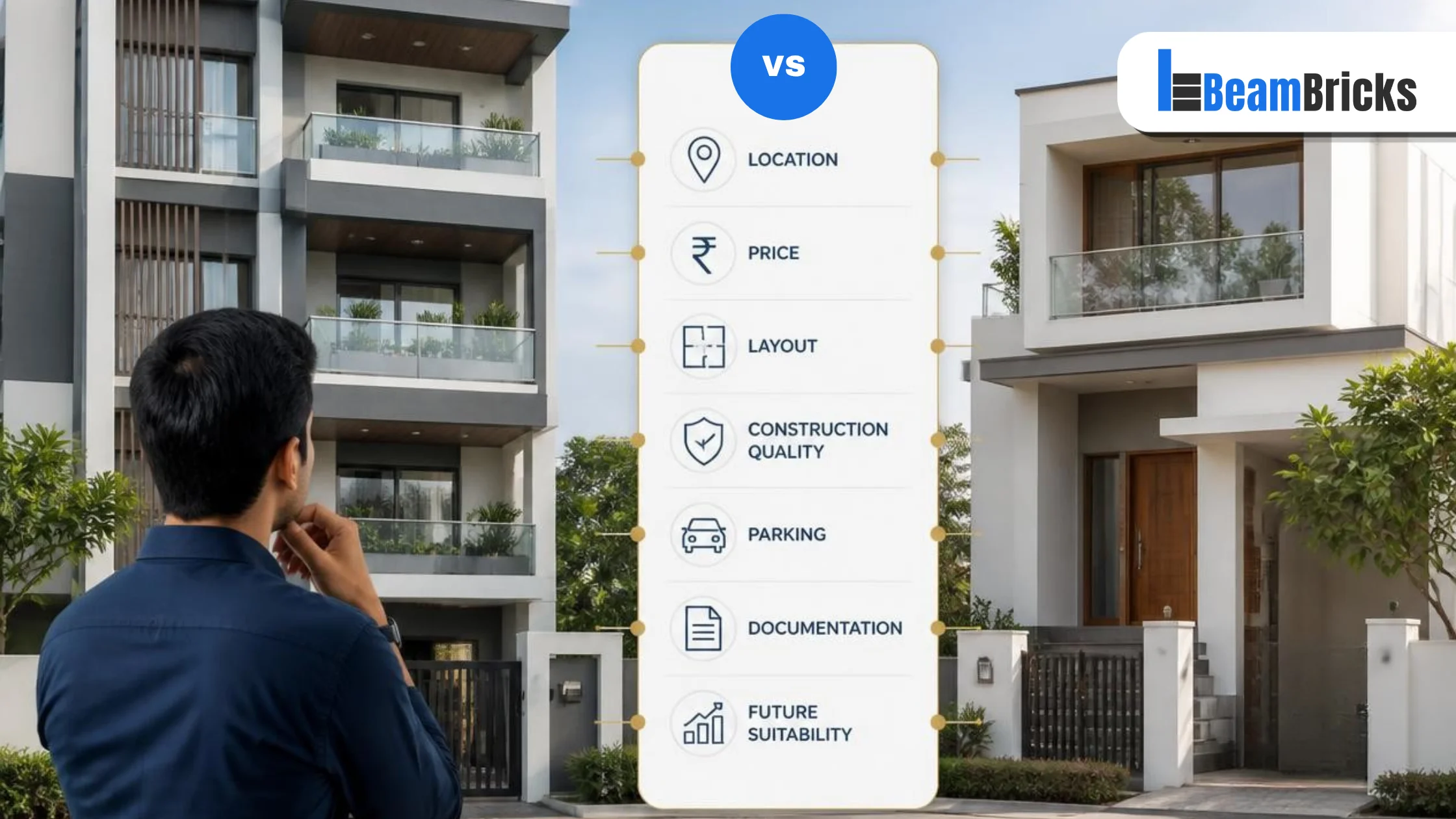
Comparing two residential properties before buying can be difficult – when both appear attractive at first glance. One may have a better location – while the other offers more space. One may be newer – while the other may be available at a lower price. Instead of choosing based only on price, size or appearance – buyers should compare both properties against the factors that actually matter to their lifestyle, budget and long-term plans.
A structured property comparison can help you understand what you are really getting for your money and identify which property better matches your requirements.
Whether you are comparing two builder floors, independent houses, apartments or other residential properties – the following framework can help you make a more informed decision.
1. Start With Your Actual Requirements
Before comparing Property A and Property B, define what you need from your future home.
A property that is excellent for one buyer may not be suitable for another. For example – a smaller home closer to daily conveniences may be more practical for one family – while another may prioritise a larger layout, additional parking or future expansion possibilities.
Start by listing your priorities:
- Preferred location
- Property type
- Number of bedrooms
- Minimum usable space
- Budget
- Parking requirement
- Floor preference
- Construction age
- Natural light and ventilation
- Accessibility
- Nearby schools, healthcare and daily conveniences
- Future family requirements
- Resale or rental considerations
Separate these into must have features and nice to have features.
This prevents attractive but less relevant features from influencing your decision too heavily.
2. Compare the Exact Location, Not Just the Locality
Two properties can be in the same locality but still offer very different experiences.
When comparing properties – look beyond the locality name and examine the exact location of each property.
Consider:
- Approach road
- Road width
- Traffic & congestion
- Distance from main roads
- Access to public transport
- Nearby markets and everyday facilities
- Schools and healthcare
- Parks and open spaces
- Surrounding development
- Noise levels
- Parking conditions
- Overall neighbourhood environment
For example, two homes may both be described as being in the same residential area – but one could be located on a wider and more accessible road while the other may be deeper inside a congested lane.
The difference may matter considerably in everyday use and future resale.
If you are comparing properties in Sainik Colony, understanding the specific pocket and surroundings can be just as important as comparing the properties themselves.
For more information about the locality, see our guide to Property in Sainik Colony, Faridabad.
3. Compare Carpet Area, Built-Up Area and Plot Size Correctly
One of the most common mistakes buyers make is comparing properties simply by the advertised area.
A property may be advertised using carpet area, built-up area, super built-up area or plot area depending on the property type and listing.
These measurements are not interchangeable.
When comparing two homes, find out:
- Carpet area
- Built-up area
- Plot area, where applicable
- Property dimensions
- Balcony or terrace area
- Common areas, where applicable
For example, a larger advertised area does not automatically mean more usable living space.
Try to understand how much space you and your family can actually use.
This becomes particularly important when comparing builder floors with different layouts or independent houses built on different plot sizes.
4. Compare the Layout and Usable Space
Two properties with similar areas can feel completely different because of their layouts.
Look at:
- Bedroom sizes
- Living and dining space
- Kitchen layout
- Number and placement of bathrooms
- Storage
- Passage space
- Balcony placement
- Natural movement between rooms
- Privacy between bedrooms & living areas
Ask yourself –
Does the layout work for the way I actually live?
A property with slightly less total area may provide a more practical layout than a larger property where considerable space is lost to passages or poorly planned rooms.
If you work from home – for example, a flexible room may be more valuable to you than a slightly larger living room.
5. Compare Natural Light & Ventilation
This is an important factor that is sometimes overlooked during a property visit.
Don’t evaluate natural light & ventilation only from photographs.
During a site visit, check:
- Direction of windows
- Number of windows
- Cross ventilation
- Sunlight during different parts of the day
- Air movement
- Obstructions from neighbouring buildings
- Balcony orientation
- Distance between surrounding structures
If possible – visit both properties at a similar time of day.
A home that appears bright in photographs may feel very different when you see it personally
6. Compare Construction Quality and Property Condition
A newer property is not automatically better constructed, and an older property is not necessarily a poor purchase.
Look at the actual condition of each property.
Check:
- Walls and ceilings
- Flooring
- Doors and windows
- Plumbing fixtures
- Electrical fittings
- Kitchen construction
- Bathroom condition
- Waterproofing
- Signs of seepage or dampness
- Quality of finishing
- Structural condition where relevant
For a newly constructed property, pay attention to workmanship rather than assuming that “new” means “problem-free”.
For a resale property, understand its age, maintenance history and any repairs or renovation that may be required.
The potential cost of immediate repairs should be considered when comparing the two properties.
7. Compare Parking and Accessibility
Parking can significantly affect the practical value of a residential property.
Find out exactly what is being offered.
Ask:
- Is parking available?
- Is it designated or shared?
- Is the parking space suitable for your vehicle?
- Is access convenient?
- Can visitors park nearby?
- Is there enough space for future requirements?
- Also consider accessibility.
For some families, a ground-floor property may be preferable. Others may value a higher floor for privacy, views or ventilation.
If the building has a lift, check its condition and maintenance arrangements.
The “best floor” depends on the buyer’s needs, so compare accessibility rather than assuming that one floor is universally better.
8. Compare the Total Cost, Not Just the Asking Price

The cheapest property is not necessarily the better deal.
When comparing residential properties, calculate the overall cost of ownership and immediate expenditure.
Consider:
- Property price
- Registration-related costs
- Stamp duty, where applicable
- Brokerage, if applicable
- Legal or professional verification
- Renovation
- Repairs
- Interiors
- Parking-related costs
- Loan-related expenses
- Moving costs
- Expected maintenance
For example, Property A may cost less initially but require substantial renovation. Property B may cost more but need very little immediate work.
Instead of asking only:
“Which property is cheaper?”
ask:
“Which property gives me better value for the total money I expect to spend?”
Actual transaction costs and applicable government charges can vary, so buyers should verify current requirements before making financial decisions.
9. Compare the Price on a Meaningful Basis
Price comparison becomes more useful when you understand what you are comparing.
Depending on the property type, buyers may compare:
- Total property price
- Price per square foot
- Price per square yard
- Carpet-area cost
- Plot size
- Built-up area
- Construction age
- Location
- Parking
- Construction quality
However, price per square foot alone should not decide the purchase.
A property with a lower rate may have inferior access, smaller usable space, older construction or other limitations.
Similarly, a higher-priced property may offer better construction, location or layout.
The objective is not to find the lowest price. It is to understand whether the price is reasonable in relation to the property’s overall characteristics.
10. Compare Documentation and Ownership Details
A residential property should not be evaluated only by its physical appearance.
Before making a commitment, understand the property’s ownership and documentation.
Depending on the property and transaction, relevant checks may include:
- Ownership/title documents
- Previous transaction documents
- Sale deed
- Property registration
- Property tax records
- Applicable approvals
- Encumbrance-related checks
- Loan or mortgage status
- Outstanding dues
- Other documents relevant to the property
Documentation requirements can differ depending on the property, ownership structure and transaction.
For significant transactions, independent legal or professional verification can be valuable.
A property that looks perfect physically may still require careful documentation checks.
11. Compare Future Suitability
A home should not only fit your current needs. Consider how well it may work for you several years from now.
Ask:
- Will your family size change?
- Will you need a home office?
- Will elderly family members live with you?
- Will you need additional parking?
- Is the layout flexible?
- Could you need more storage?
- How easy would it be to sell later?
- Is the location likely to remain suitable for your lifestyle?
A property that meets 100% of your current needs – but creates problems in two years may not be the better choice.
Think about your likely future requirements, not just today’s preferences.
12. Compare Resale and Investment Potential Carefully
If resale or investment matters to you – compare factors that could influence future demand.
Consider:
- Location
- Accessibility
- Property type
- Layout
- Construction quality
- Parking
- Documentation
- Condition
- Local demand
- Ease of resale
Avoid assuming that every property will appreciate at the same rate.
Real estate outcomes depend on several factors, including purchase price, market conditions, property characteristics, location and holding period.
For a self-use buyer, lifestyle suitability may matter more than speculative appreciation.
For an investor, the analysis may need to include expected rental demand, liquidity, holding period and other financial considerations.
A Simple Property Comparison Checklist 📋
Once you have inspected both properties, put the information into a simple comparison.
- Location
- Property Type
- Carpet Area
- Built-Up Area
- Plot Area
- Layout
- Natural Light
- Ventilation
- Construction
- Property Age
- Parking
- Floor
- Accessibility
- Documentation
- Asking Price
- Estimated Additional Costs
- Renovation Required
- Future Suitability
- Resale Considerations
You can also give each factor a score from 1 to 5 – but don’t allow the final score to replace your judgement.
Some factors are more important than others.
For example, a buyer may accept a smaller balcony but not compromise on location or documentation.
Don't Let One Attractive Feature Decide Everything
Property buying can become emotional.
A beautifully furnished home may immediately feel better. Another property may have a slightly less impressive interior but a better layout, location or construction quality.
Try to separate presentation from actual value.
During the comparison, ask:
What am I paying for?
What am I getting?
What compromises would I be making?
Which compromises can I live with?
This makes the decision more objective.
How BeamBricks Helps You Compare Properties
Finding properties is only one part of the buying process. The more difficult part can be identifying which options actually fit your requirements.
At BeamBricks, our approach is based on understanding what the buyer is looking for and using our local property network to explore suitable options.
Instead of asking you to evaluate an endless list of properties, we focus on helping you narrow the search around relevant requirements.
The process is simple:
Tell us what you need → Understand your requirements → Explore suitable options → Compare the properties → Decide what works for you
We don’t believe the buyer should choose a property simply – because it is available or because someone recommends it.
The right property depends on your budget, priorities, lifestyle and future plans.
We don’t sell properties. We filter them for you.
If you are exploring residential property in Sainik Colony – you can also explore Properties for Sale in Sainik Colony, Builder Floors in Sainik Colony, Independent Houses in Sainik Colony and Residential Plots in Sainik Colony.
Final Takeaway
The best way to compare two residential properties is to – look beyond the asking price and evaluate both properties against the same set of criteria.
Compare the exact location, usable area, layout, construction quality, natural light, ventilation, parking, documentation, total cost and future suitability.
Most importantly, compare them against your requirements, not somebody else’s idea of the perfect property.
A property is not necessarily better because it is – bigger, newer or more expensive. It is better when its – location, space, quality, cost and other characteristics make sense for the person buying it.
When you approach property comparison systematically, you can reduce emotional decision-making, identify important differences and make a more informed choice.
Frequently Asked Questions
Compare both properties using the same criteria, including location, carpet and built up area, layout, construction quality, parking, natural light, ventilation, documentation, total cost & future suitability. Start by identifying your must have requirements & then evaluate both properties against them.
The cheaper property is not always the better choice. Compare the total cost, condition, location, usable space, construction quality, documentation and future requirements before deciding. A property with a higher asking price may provide better overall value - while a cheaper property may require significant additional spending.
There is no single factor that is most important for "every buyer." Location, budget, property condition, usable space and documentation are generally important - but their priority depends on your requirements. A good comparison starts by identifying which factors you cannot compromise on.
Don't compare only the total asking prices. Consider carpet area, built up or plot area, location, construction age, condition, parking, layout & other property specific features. Price per square foot or square yard can provide useful context - but it should not be the sole basis for choosing a property.
Check the exact location, property area, layout, construction quality, age, natural light and ventilation, parking, accessibility, ownership and documentation, asking price, additional costs, renovation requirements and future suitability. Visiting both properties and comparing them using the same checklist can make the decision easier.
Share: